

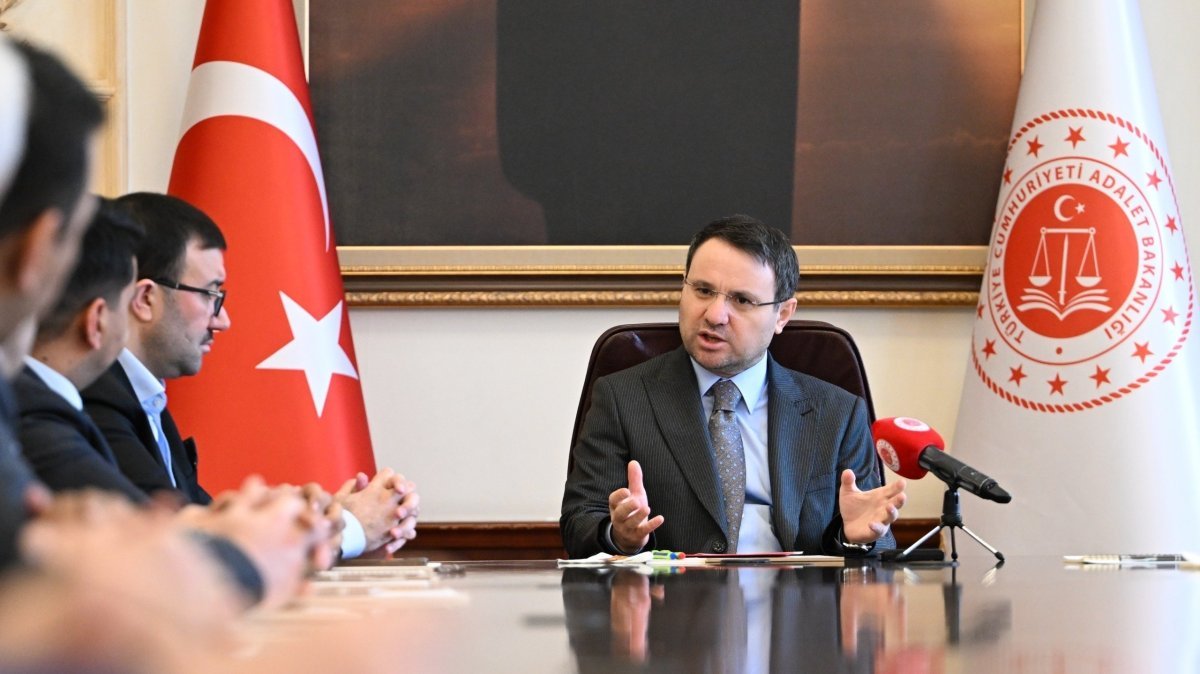
The European Parliament’s annual report on Türkiye, adopted Wednesday, has sparked debate after it called for consideration of sanctions against Justice Minister Akın Gürlek under the European Union Global Human Rights Sanctions Regime and included strong criticism of an ongoing court case in Türkiye.
The report focused largely on concerns over democracy, the rule of law, judicial independence, the detention of Istanbul Mayor Ekrem Imamoğlu, invalidation the main opposition Republican People’s Party’s (CHP) leadership congress, trustee appointments and the continued stagnation of Türkiye’s European Union accession process. Moreover, the section that has drawn the greatest attention in Türkiye is the explicit reference to Gürlek.
Experts, however, warn that such approaches could further erode trust in the European Union at a time when regional conflicts are intensifying and Türkiye’s strategic importance is growing, potentially undermining the bloc’s credibility and its image as a reliable and impartial actor.
Reminding that the the EU Global Human Rights Sanctions Regime is primarily designed to address serious violations such as genocide, crimes against humanity, torture and other cruel, inhuman or degrading treatment or punishment, slavery, and extrajudicial, arbitrary, or unlawful executions and killings, “the inclusion of such references in the report has significantly diminished trust in the EU among many in Türkiye,” Özgür Ünal Eriş, Jean Monnet Chair, professor at the Department of International Relations and Political Science at Istanbul 29 Mayıs University told Daily Sabah.
The European Parliament on Wednesday adopted a report on Türkiye drafted by European Parliament rapporteur Nacho Sánchez Amor, including a call for sanctions against Minister Akın Gürlek, with 381 votes in favor, 107 against and 171 abstentions.
The draft text, which was put to a vote on June 17, proposed adding Gürlek to a sanctions list under the EU Global Human Rights Sanctions Regime.
The report prompted swift criticism from several Turkish officials and politicians, who argued that the document reflected a politically motivated and one-sided approach toward Türkiye.
Eriş noted that the European Parliament lacks the authority to impose sanctions, stressing that its reports are political recommendations rather than legally binding decisions. Any sanctions measure, she said, would require action by the EU’s High Representative for Foreign Affairs and Security Policy as well as unanimous backing from all member states.
Following the adaptation of the report, Türkiye’s Foreign Ministry immediately rejected the European Parliament’s 2025 report on the country, saying it contained assessments that were disconnected from reality and based on misinformation and unfounded allegations.
In a written statement, the ministry said the report reflected the ideological biases of some members of the European Parliament and had been prepared within the framework of a deliberate political agenda.
According to the ministry, the report contained assessments that are incompatible with facts and are based on unfounded claims and misinformation circulated by anti-Türkiye circles.
“The Turkish judiciary, one of the fundamental pillars of our state sovereignty, is not open to interference by any international institution, external actor or political group,” it was stressed.
“Given Türkiye’s NATO membership, its role in managing migration flows and its significance to regional security, the prospect of EU sanctions being implemented in the near term appears low,” Eriş argued.
“At the same time, such proposals risk undermining the EU’s own credibility.”
She remarked that the bloc has long faced criticism for failing to apply the principle of good faith consistently, allowing bilateral disputes involving member states to shape Türkiye’s accession process and increasingly treating Türkiye as a strategic partner rather than a prospective member.
“At a time when regional conflicts are intensifying and Türkiye’s strategic importance is growing, these approaches could further erode confidence in the European Union as a reliable and impartial actor,” the expert added.
Minister Akın Gürlek rejected criticism contained in a European Parliament report on Türkiye and dismissed calls for possible sanctions against him, saying the Turkish judiciary acts independently and that attempts to target the country’s judicial institutions amount to interference in its sovereign affairs.
In a statement posted on social media last week, Gürlek said Türkiye remains committed to the principles of democracy and the rule of law and operates as an independent and sovereign state with a long-established state tradition.
He added that what he described as a politically motivated approach encouraged by some circles within the European Parliament was damaging the credibility of the institutions they represent.
Gürlek also argued that European Parliament reports are political documents with advisory value and do not carry legal force.
“No one should assume that the Turkish judiciary can be placed under pressure or tutelage. We will continue to fulfill our duties to protect public order, the state and the rule of law.”
Moreover, Eriş also pointed to that while the European Parliament has every right to scrutinize developments concerning democracy and the rule of law, the report’s treatment of issues in the Aegean and Eastern Mediterranean raises serious questions about its impartiality.
“Such one-sided assessments undermine the credibility of the institution and weaken confidence in its ability to act as an objective actor,” she said.
Several amendments incorporated into the final text drew particular attention, including provisions supporting Greece’s positions in the Aegean Sea and criticizing Türkiye’s “Blue Homeland” maritime doctrine.
While encouraging the two countries to continue pursuing dialogue and cooperation, the report stated: “The European Parliament expresses deep concern that Türkiye continues to maintain its formal threat of war (casus belli) against Greece should Athens exercise its legal right under Article 3 of the United Nations Convention on the Law of the Sea to extend its territorial waters in the Aegean Sea to 12 nautical miles.”
The Blue Homeland doctrine encompasses Türkiye’s maritime jurisdictions in the Black, Mediterranean and Aegean seas, as well as the country’s exclusive economic zone and continental shelf in line with United Nations resolutions.

