
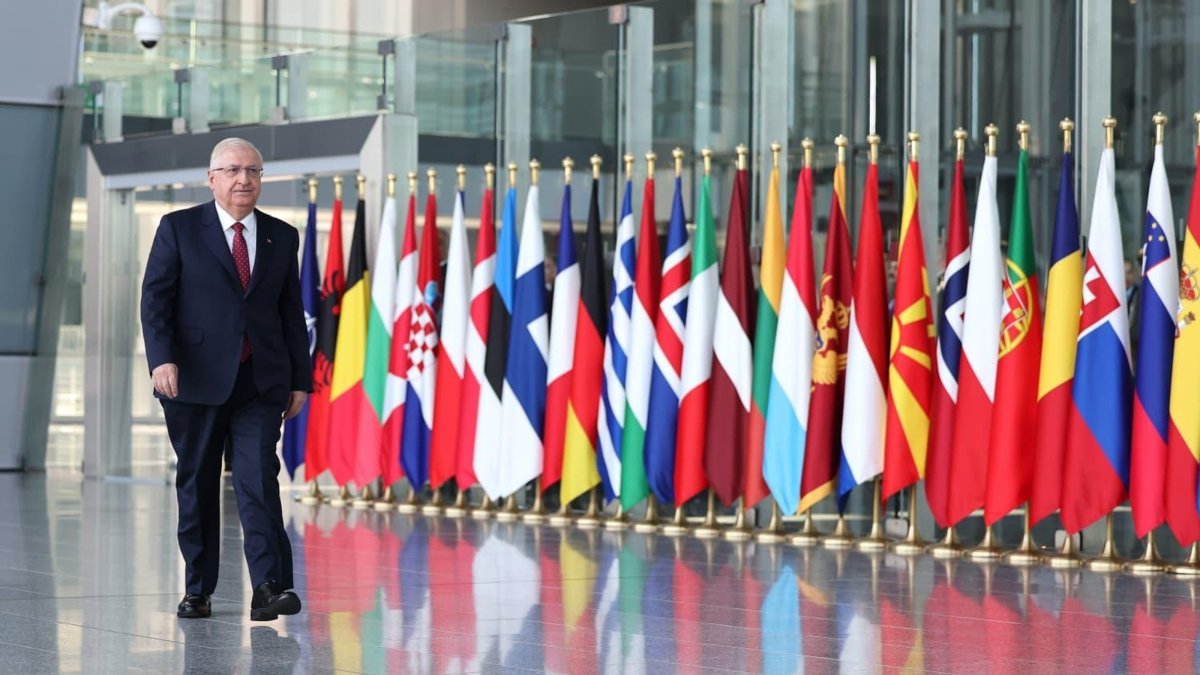
Defense Minister Yaşar Güler said Friday that Türkiye views the upcoming NATO leaders’ summit in Ankara as a critical milestone that will help shape the alliance’s strategic direction amid an increasingly complex global security environment.
Speaking to Turkish journalists on the sidelines of a NATO defense ministers meeting in Brussels, Güler said the July 7-8 summit in the Turkish capital would be more than a gathering of allied leaders.
“We do not see the Ankara summit merely as a leaders’ meeting,” Güler said. “We believe it will be a significant turning point demonstrating NATO’s determination to adapt to the evolving security environment and shaping its strategic orientation for the future.”
The defense minister meeting, held ahead of the NATO summit, focused on the alliance’s deterrence and defense posture, support for Ukraine and broader security challenges facing member states, Güler said.
He noted that Türkiye had briefed allies on its contributions to NATO, progress toward defense spending commitments, preparations for the Ankara summit and its support for Ukraine.
Güler remarked that NATO currently faces one of the most challenging security environments in its history, citing conventional military threats alongside cyberattacks, hybrid warfare, terrorism, energy security risks and regional instability.
“Türkiye is not only one of NATO’s geographical centers but also an inseparable part of its strategic thinking and operational capacity,” he said.
The minister described Türkiye’s hosting of the summit as a reflection of its military contributions, operational experience and ability to generate security within the alliance. He also highlighted President Recep Tayyip Erdoğan’s diplomatic efforts, saying Türkiye has maintained a unique position within NATO through its emphasis on dialogue, crisis management and regional stability.
“Our goal is to strengthen NATO’s unity and solidarity, underline our shared commitment to Euro-Atlantic security and contribute to a strategic vision that will make the alliance better prepared for future threats,” Güler stressed.
He added that Ankara expects the summit to reinforce collective defense principles and reaffirm allies’ commitment to Article 5, NATO’s cornerstone mutual defense clause.
Güler also emphasized the growing role of Türkiye’s defense industry in supporting NATO capabilities.
“The success achieved by our defense industry contributes not only to Türkiye’s national security but also to NATO’s collective defense,” he said. “Strong defense industries mean stronger deterrence and a stronger NATO.”
He said a Defense Industry Forum scheduled to take place during the summit would help deepen cooperation among allies and noted that several NATO defense ministers had recently expressed interest in expanding collaboration with Türkiye’s defense sector.
Türkiye, which possesses NATO’s second-largest military, remains one of the alliance’s most active contributors, Güler said, highlighting the country’s involvement in military training, exercises, operations and command-and-control missions.
He noted that Türkiye will assume command of the Allied Reaction Force, one of NATO’s key force structures, in the coming period, describing the move as a sign of Ankara’s reliability and strategic importance within the alliance.
“Türkiye is not merely a country contributing to NATO’s security,” Güler said. “With its military capacity, operational experience and leadership responsibilities, it is among the leading nations shaping the alliance’s deterrence, resilience and future.”
Regional developments
Addressing the war between Russia and Ukraine, Güler said the conflict continues to affect European security architecture, energy security, global trade routes and NATO’s agenda.
He reiterated Türkiye’s support for regional stability in the Black Sea and stressed Ankara’s commitment to implementing the Montreux Convention.
“The stability of the Black Sea is an inseparable part of Euro-Atlantic security,” he said.
Güler also highlighted security challenges affecting NATO’s southern flank, including terrorism, irregular migration, energy-related risks, regional conflicts and hybrid threats.
“Türkiye is among the allies that directly confront regional threats while also making critical contributions at the center of the alliance,” he said.
Turning to developments in the Middle East, Güler welcomed the recently announced agreement aimed at ending hostilities involving Iran, the United States and Israel. He said Türkiye was prepared to support mine-clearing operations in the Strait of Hormuz if necessary and remained committed to safeguarding maritime security and freedom of navigation under international law.
The minister said Ankara continues to advocate dialogue and diplomacy as the preferred means of resolving regional disputes while taking necessary measures to protect its national security.
Güler also criticized a recent defense-related agreement signed between France and the Greek Cypriot administration, describing it as a step that could undermine regional balances and contradict international law.
“Actors that are expected to produce security should avoid actions that deepen regional tensions and instead prioritize dialogue, cooperation and a shared understanding of security,” he said.
He reiterated Türkiye’s commitment to protecting the rights and security of Turkish Cypriots and said any initiative targeting the interests of Türkiye or the Turkish Republic of Northern Cyprus would have little chance of success.
Concluding his remarks, Güler said Türkiye had become one of the central pillars of regional and trans-Atlantic security.
“There is now a very clear reality,” he said. “Türkiye is not on the periphery of the security architecture; it is at its center. As NATO’s future is shaped, Türkiye will continue to be among the allies that contribute to decisions, assume responsibilities and generate security.”

