

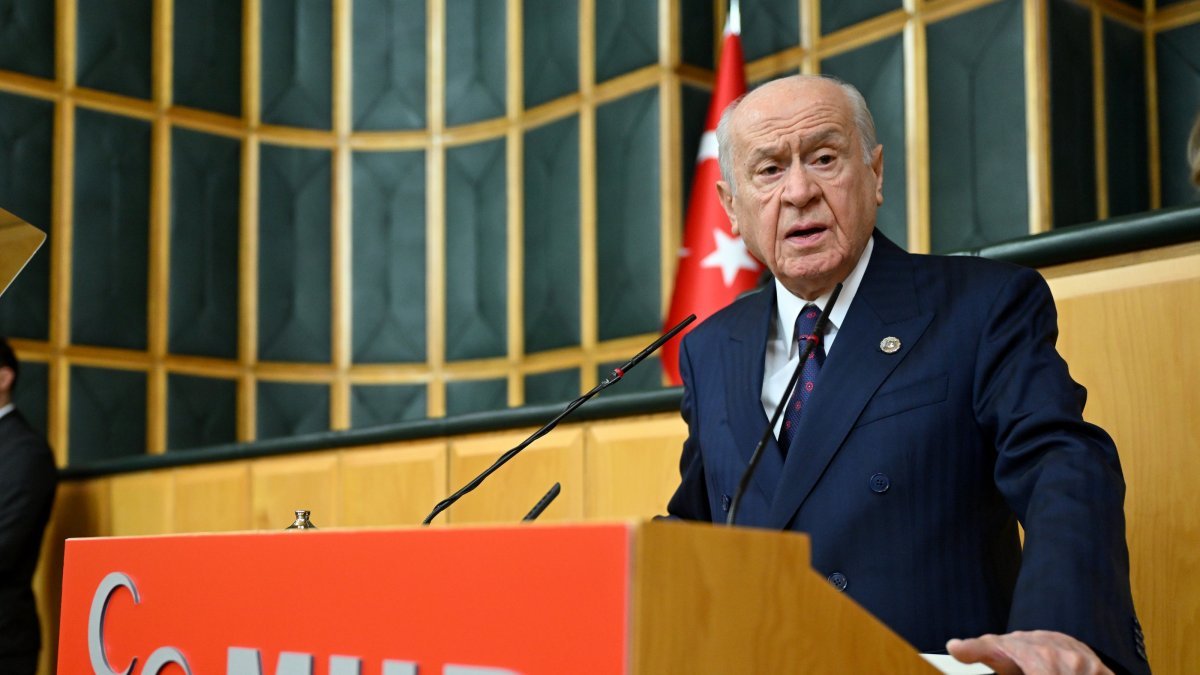
Devlet Bahçeli, leader of government ally Nationalist Movement Party (MHP), called for the establishment of a “World Peace Council at a time when the possibility of a third world war is voiced strongly.”
Addressing the parliamentary group meeting of his party on Tuesday in Ankara, the veteran politician said it should be led by the U.N. secretary-general and include Türkiye, the United States, Russia, China and the European Union. “It is an obligation for humanity,” he said. He voiced the same call last week.
Bahçeli’s call aligns with President Recep Tayyip Erdoğan’s oft-repeated motto “the world is bigger than five,” which refers to an expected change in the five permanent members of the U.N. Security Council. Like Erdoğan, Bahçeli advocates for a major change in the world order where major powers engage in actions affecting third countries while the international bodies are accused of inaction.
“It is inevitable to demonstrate a new global will based on justice and balance, to replace a hypocritical understanding of the order where peace is only a word while wars are a reality. Türkiye is ready to contribute to this mission stemming from its historic responsibility,” he said, quoting Mustafa Kemal Atatürk, founder of the Republic of Türkiye: “Peace at home, peace in the world.”
The MHP leader’s speech mostly concentrated on the U.S.-Israel-Iran war, and he had nothing but harsh words against Israel, which he branded as “the spoiled child of the United States.”
Stating that the current global landscape is a multilayered web of calculations where diplomacy is interwoven with military operations, energy security with border safety, and international law with a racist and sectarian mindset, Bahçeli recalled the attacks by the U.S. and Israel against Iran. On talks for a cease-fire, he said it was not a comprehensive reconciliation but rather a “temporary pause that allows the parties to review their positions at a point where they have failed to achieve their strategic and fundamental goals.”
“Direct U.S.-Iran negotiations have ended without reaching any agreement. Following this struggle, which continues to exert its full weight not only on the ground but also on diplomatic grounds, we see that there is no finished crisis, but only an “arm-wrestling” match that has changed form. The inconclusive talks in Islamabad have further strengthened the possibility of regional conflicts evolving into global destruction. Just as uncontrolled and unchecked power competition and the ambition for armament cause bombs to explode in the Middle East today, they will pave the way for even greater destruction in the heart of Europe, the junctions of Asia and the fragile basins of Africa tomorrow,” he underlined.
He stated that humanity, already shaken by the global COVID-19 pandemic, is being relentlessly tossed about by the Ukraine-Russia war, the disrupted trade security in the Red Sea and the Black Sea, the humanitarian tragedy in Gaza, the destruction in Lebanon, and the crises breaking out in Ethiopia, Sudan and Somalia.
On Lebanon, Bahçeli said that Israel’s attacks there demonstrated that Zionists were not willing to leave Lebanon. “Israel’s attacks violating Lebanon’s sovereignty and territorial integrity should immediately stop,” he said. Bahçeli noted that Israel’s attacks on the regional countries increased, and it was the real and only culprit of the ongoing conflicts. “The international order’s real problem is failure to exert pressure on Israel. World’s double standards are revealed in light of tolerance for spoiled child of the United States,” he stressed.
Terror-free Türkiye
Bahçeli reasoned that developments in the region led the public to understand their insistence and commitment to the terror-free Türkiye initiative. Bahçeli launched the initiative in 2024 for disarmament of the PKK terrorist group, which has members in Iraq, Syria and Iran. The PKK complied with the initiative and is currently in a disarmament process, monitored by the Turkish intelligence.
In his remarks on Tuesday, Bahçeli said that beyond eliminating terrorism, the initiative would revive regions where fears of terrorism and insecurity had dominated for years. “It is no longer a dream that the eastern, southeastern Anatolia, border areas, villages, highlands and plains will join mobilization for local production and agriculture after they free themselves of the shackles of terrorism,” he said.

