
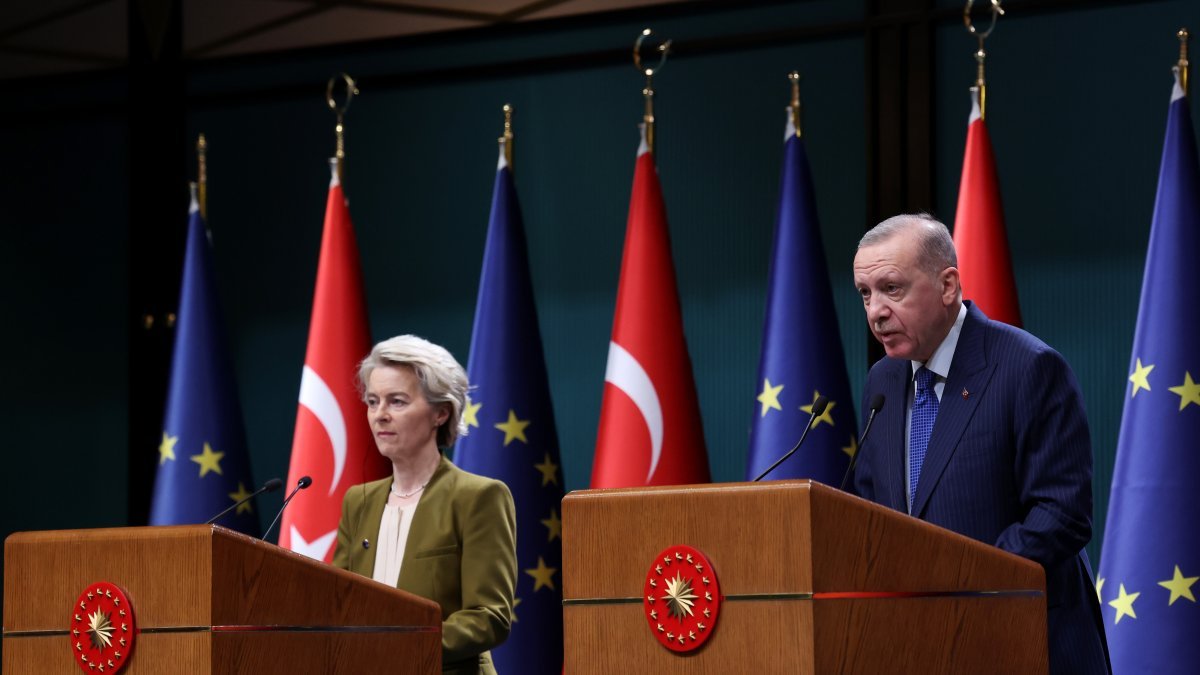
The EU and the United States have grown apart recently, but they appear to agree on one thing: Türkiye is no longer a country to be underestimated in global affairs.
Statements by European Commission President Ursula von der Leyen, who warned against “Turkish influence” in Europe, may be downright hostile, but it is also an acknowledgement of the fact that Türkiye has cemented its place in the world as a key actor, rather than a pawn on the global chessboard. Add this to U.S. Ambassador Tom Barrack’s remarks describing the country as a vital partner for the United States, and it is clear that Türkiye is viewed by the West as an indispensable presence in international relations.
Now, the question is how the West will move forward in its relations with Türkiye. The EU has long maintained its stance on keeping Türkiye at its door, while Ankara was forced to establish one-on-one beneficial cooperation with members of the bloc, which always placed obstacles before it. As for the U.S., Washington seems more engaged with Ankara under the Trump administration, though a solid outcome of renewed ties is yet to be seen, especially in terms of lifting the sanctions.
Under the leadership of President Recep Tayyip Erdoğan, Türkiye has shifted its absolute alignment with the EU in terms of strategic cooperation to a balanced relationship. It did not lose the ambition for full membership to the bloc, but did not idle around while waiting for membership invitation after completing most of the criteria the EU asked to fulfill. It built new partnerships across the globe rather than remaining focused on Europe.
Nevertheless, as the U.S. under Trump and the Russia-Ukraine conflict upset the EU’s relatively serene world detached from international crises, the Turkish “influence” von der Leyen emphasized may be an ingredient to survive this new era for Europe. Türkiye’s overtures to the bloc in recent months show Ankara needs Brussels as much as it needs Ankara. In other words, both sides need each other, though in different fields. Take the economy, for instance. Türkiye is one of Europe’s largest trading partners. The rise of the Turkish defense industry and Türkiye’s appetite to bolster its defenses with EU products such as Eurofighter jets can also contribute to reinvigorating ties that took blows, especially in the mid-2010s, amid separate crises with members of the bloc, such as the Netherlands.
On a side note, Türkiye has not slammed von der Leyen’s remarks outright as it would have done in the past, and the EU was quick to clarify them. A commission spokesperson told Anadolu Agency (AA) on April 21 that von der Leyen’s remarks were merely “a recognition of its geopolitical clout, size and ambitions.” These attempts to downplay or ignore the remarks also highlight that both sides are keen on maintaining ties in a time of uncertainty. For Türkiye, this silence is something that may be associated with Ankara’s ultimate ambition in peace diplomacy: making new friends and keeping old foes at bay. Speaking of peace diplomacy, Türkiye is still essential for the EU as the only country that can talk to both sides in the Russia-Ukraine conflict, and as Kyiv recently pointed out, an ally trustworthy enough for them to host a possible Putin-Zelenskyy meeting. At the end of the day, Türkiye may address the EU’s concerns of lingering conflict that occasionally threatens to spill over into other countries by securing a peace deal, and at the same time, may help the bloc by boosting its defenses as a key partner through the SAFE mechanism Ankara seeks to benefit from.

