

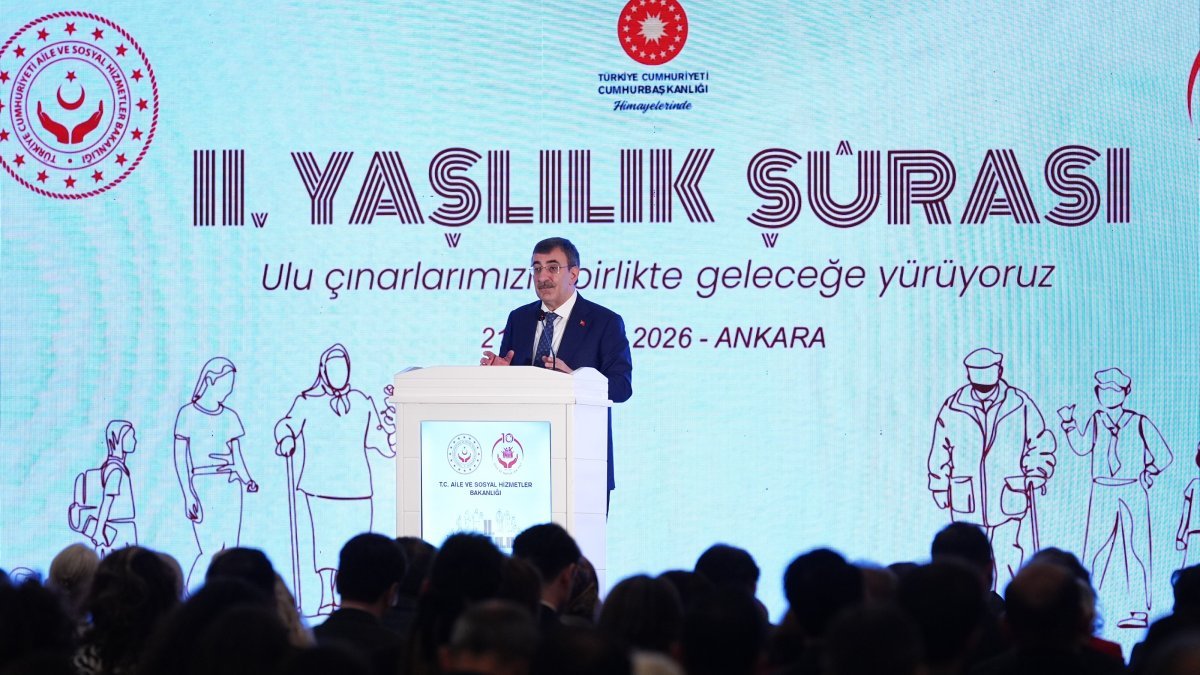
Vice President Cevdet Yılmaz spoke at the 2nd Council on Aging on Thursday and highlighted that Türkiye was on the threshold of a demographic transformation.
The council was first held in Ankara in 2019, which was declared the “Year of the Elderly.” The second edition, organized by the Ministry of Family and Social Services, sought to address the issue of an aging population.
Yılmaz said in a speech at the council that projections by the Turkish Statistical Institute (TurkStat) indicated that the number of the elderly would make up 13.5% of the total population in 2030.
“This data demonstrates that we have a rapidly aging population,” he said.
The vice president noted that, in addition to the continuous and sharp decline in the fertility rate, the mortality rate has decreased as a result of improvements in living standards and welfare, as well as advances in the field of health.
“Türkiye ranks 75th among 194 countries in 2025 in terms of the proportion of the elderly population. While the proportion of elderly people in our country was 5.7% in 2000, it exceeded 10% for the first time in 2023, placing Türkiye among the group of ‘very old countries.’”
Yılmaz also stated that out of more than 7 million households with at least one elderly individual, nearly 2 million consist of elderly people living alone. “This picture shows us not only a demographic change but also that loneliness in old age is becoming an increasingly serious social problem. In order to determine how effectively the elderly population experiences the aging process, the Active Ageing Index (AAI) was developed with the contributions of the United Nations Economic Commission for Europe (UNECE). While the most recent AAI value published for EU member states for 2018 was 36.8, this figure was 29.7 for Türkiye in 2024. This indicates that we still have much to do in making the aging population more active and productive.”
Within the framework of the Medium-Term Program (OVP), Yılmaz stated that adapting to Türkiye’s changing demographic structure and strengthening care services for the elderly are among their priority goals. He noted that efforts are ongoing to implement a “Long-Term Care Insurance” system. He added that multidimensional policies have been put into practice to improve the quality of life of elderly individuals by enabling them to effectively exercise their rights in areas such as care, health, social services, employment, accessibility and social participation.
“While in 2002 we provided services to approximately 5,000 elderly people in 63 public nursing homes, today we serve around 15,000 citizens in 178 public nursing homes. In addition, we provide these services to nearly 30,000 citizens in total through other public institutions and private nursing homes. In 2026, we will further expand this infrastructure by opening new nursing homes with a capacity of 900 in eight provinces. We do not limit these services to accommodation; we offer our elders a holistic approach, including health care, psycho-social support, rehabilitation, and social, sports and cultural activities. In line with this approach, we are expanding service models closer to a home environment through the Elderly Living Home Project. Moreover, we support families and elderly individuals by providing up to 45 days of guest care services within a year when needed,” he said.
Yılmaz also stated that they are implementing important projects to support the active participation of elderly individuals in social life.
Family and Social Services Minister Mahinur Özdemir Göktaş, on the other hand, said that through the second council and workshops held in all 81 provinces, they comprehensively evaluated findings and solution proposals from the field, and conducted the Elderly Field Research with contributions from 24,697 people across the country.
“The ultimate goal we aim to achieve with the 2nd Council on Aging is to make the services we provide more effective, more widespread and higher in quality,” she said.

