

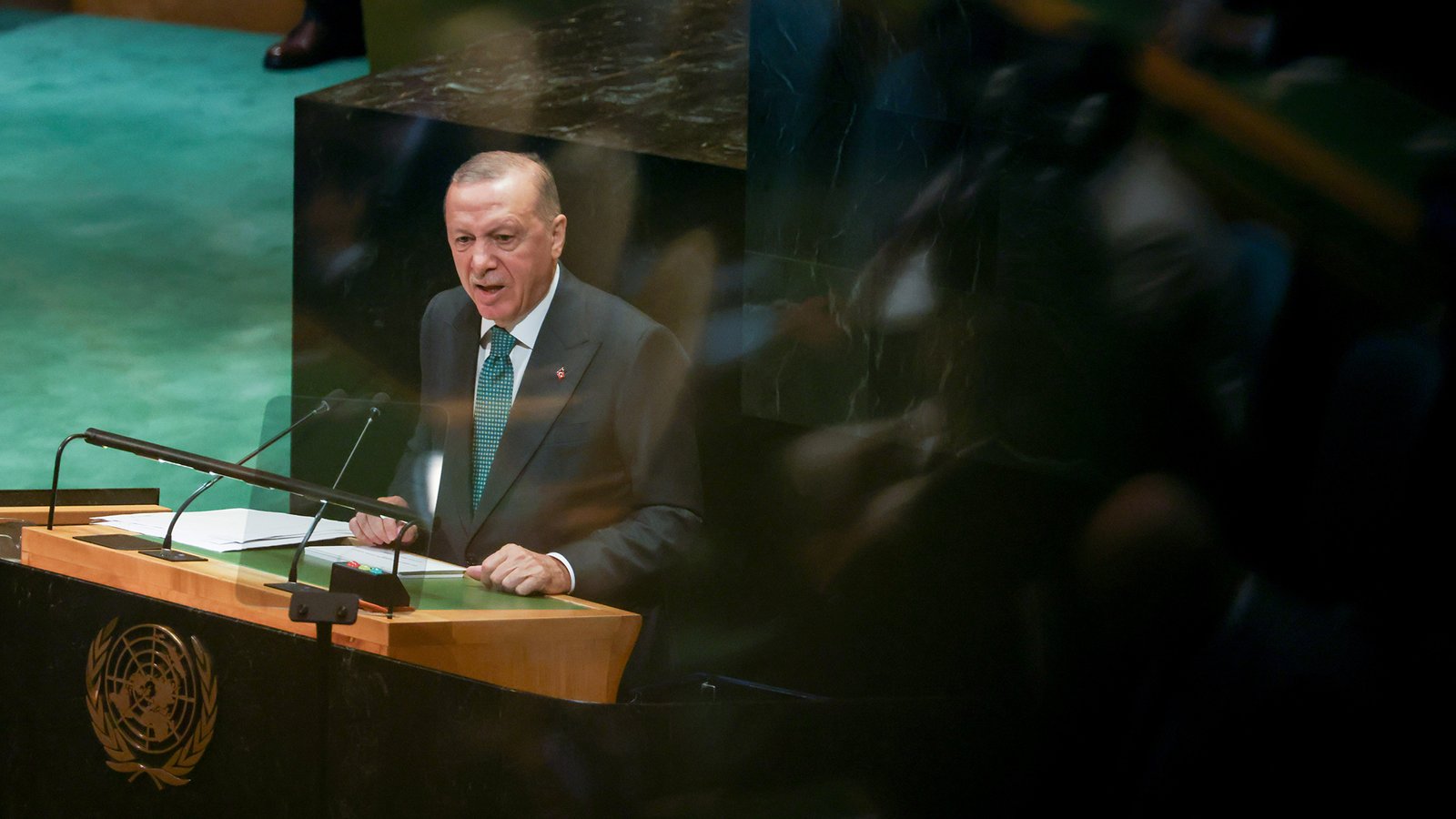
Beyond the Middle East, Turkish soft power—including development assistance, trade, education, and culture—has made significant inroads in the Balkans, the Caucasus, and Central Asia. Many states are now looking to Turkey for military support following the victory of Turkish-backed Azerbaijan over Armenia in the Second Nagorno-Karabakh War (2020). Africa is also a primary focus for Turkish development assistance and a major customer for Turkey’s defense industry. Turkey’s strategic ambiguity and political hybridity give Ankara an advantage with countries seeking to remain on the sidelines amid mounting competition among the West, Russia, and China.
History, Grievances, and Aspirations
From the 1950s to the 1990s, Ankara maintained a pro-Western alignment that developed in response to Soviet efforts to project power at Turkey’s expense. Along with Greece, Turkey was a focal point of the Truman Doctrine, according to which the United States would provide economic and military assistance to countries resisting attempted communist takeovers. Turkey joined NATO in 1952 in response to Soviet leader Joseph Stalin’s efforts to station Soviet troops in Turkey and contest Ankara’s control of the Bosporus and Dardanelles Straits. Turkey also signed an association agreement with the European Community in 1963, leading to the formation of a customs union that anchored Turkey’s economy to Europe and fed hopes, at least among a subset of the ruling elite, that Turkey could eventually join what became the European Union. Turkey was also one of the few Muslim-majority states to recognize Israel, and it remained neutral during the 1967 and 1973 Arab-Israeli wars, to the intense anger of many Arab governments.
This alignment with the West was never without controversy. Ruling elites from the military and security services developed a strongly anticommunist political culture, even as disaffected students, Kurds, Alevis, and other marginalized groups adopted a leftist ideology that at times saw them align with Moscow. Meanwhile, religious groups marginalized by Mustafa Kemal Atatürk’s reforms remained strongly anticommunist even as they critiqued Kemalist secularism. The 1960s saw the consolidation of a so-called “Turkish-Islamic synthesis” uniting religious and nationalist opposition to the Kemalist state.12 (Turkey’s ruling AK Party is a product of this synthesis.)
While the Kemalist elite, concentrated in the military and internal security services, maintained a pro-Western outlook throughout the Cold War, their commitment to democratic rule was limited. In 1960, the military overthrew the government of Prime Minister Adnan Menderes—Turkey’s first freely elected leader—in part over his perceived accommodation of Moscow. While the military soon returned power to civilian leaders, the ouster (and execution) of Menderes set a precedent for military intervention that continues to haunt Turkish politics. After periods of economic crisis and worsening instability and violence between leftist and nationalist groups, the military launched further coups in 1971 and 1980, each followed by large-scale repression targeting civil society. Following the return to civilian rule in 1983, the governments of Turgut Özal and Yıldırım Akbulut liberalized the economy and opened Turkey up to trade and investment from the United States and Europe.
These reforms also set the stage for Turkey’s political and economic transformation. A conservative Muslim with links to the Sufi lodges closed under Atatürk’s reforms, Özal’s economic liberalization challenged the dominance of large industrialists aligned with the Kemalist establishment. Economic growth in the 1980s and 1990s catalyzed the emergence of new industries in Turkey’s more conservative heartland. These “Anatolian Tigers” would provide much of the financial and political capital for the economically liberal, mildly Islamist AK Party, founded in the late 1990s following a split in the Islamist movement prompted by a “soft coup” in 1997.13
For the better part of a decade, the AK Party government appeared to balance Turkey’s commitment to partnership with the West and an emerging interest in acting as a regional power. Turkey played an important role in the U.S.-led mission in Afghanistan, where its forces commanded two provincial reconstruction teams from 2006 to 2014 and secured Kabul’s airport. Although Ankara refused U.S. requests to use its territory to carry out the 2003 invasion of Iraq, the George W. Bush administration held up the AK Party’s Islamically infused democracy as a model for reconciling Islam and democracy across the Muslim world. Under then–Prime Minister Erdoğan, Turkey dramatically accelerated political and economic reforms in line with its aspirations to join the European Union. Erdoğan’s government strengthened civilian control of the military, deregulated the economy, and opened Turkey to foreign investment. Responding, in part, to this apparent democratic breakthrough, Brussels opened accession negotiations with Turkey in 2005.
This democratic opening did not last, however. Over time, the AK Party shunted aside opposition parties and much of the old infrastructure of the Kemalist state. Much of this shift took place under a veneer of democratic legitimacy, as the AK Party continued winning elections while chipping away at the checks and balances necessary for real pluralism. Established business groups lost out on state contracts to firms and individuals close to the AK Party—notably the Anatolian Tigers. Religious schools received new infusions of state funding, with their graduates encouraged to enter government service.
Aiding this transformation was the AK Party’s alliance with the religious movement directed by exiled cleric Fethullah Gülen, sometimes referred to as Hizmet (“Service”). Although Gülenists provided ideological, financial, and political backing for the AK Party, they maintained their own political aspirations while establishing a strong foothold in the intelligence services, the military, and law enforcement. After a series of scandals and Erdoğan’s efforts to marginalize them, Gülenists in the military launched an abortive coup in the summer of 2016. After the coup failed, Erdoğan and his allies conducted a massive purge of the military, judiciary, and civil service that saw thousands jailed. Erdoğan blamed the United States for being slow to criticize the coup and for providing refuge for Gülen in Pennsylvania.14 Ankara would subsequently classify what it called the Fethullah Terrorist Organization (FETÖ) as a terrorist group on par with the PKK and the so-called Islamic State of Iraq and Syria (ISIS).
Another major source of grievance with the United States grew out of the war in Syria. Turkey had strongly supported the Arab Spring, hoping it would bring to power new governments whose democratic legitimacy would be based on an embrace of Islamic values. With the outbreak of civil war in Syria, Turkey called for the ouster of President Bashar al-Assad and threw its support behind a range of rebel groups, including some hardline Islamists aligned with al Qaeda. Above all, Ankara was interested in using the Syrian conflict to stamp out offshoots of the PKK in northern Syria. While ISIS carried out attacks against Turkey, the United States accused Ankara of downplaying the ISIS threat while prioritizing strikes on Kurdish forces. When ISIS began a genocidal campaign against Kurdish-speaking Yazidis in northern Syria, the United States turned to the Syrian Democratic Forces (SDF), whose largest component comprised the PKK-linked People’s Protection Units, to stem the tide. Even with the fall of the Basar al-Assad regime in late 2024, the status of the SDF and their relationship to the United States remains a source of contention.15
The Syrian war also facilitated Turkey’s rapprochement with Russia. Turkish backing for the Syrian rebels put Ankara at odds with Moscow, which had intervened militarily in 2015 to support Assad, leading to sporadic clashes between Russian and Turkish forces, including the November 2015 downing of a Russian jet that had crossed into Turkish airspace. Moscow imposed an economic blockade in response, while Turkey asserted that its Western partners provided insufficient backing for its efforts to defend its airspace. Amid the crisis over U.S. support for the SDF and the general failure of Turkey’s support for Middle Eastern democratization, Erdoğan formally apologized for the downing of the Russian jet. This step set the stage for an end to the blockade and a more general Turko-Russian reconciliation, which was accelerated despite the assassination of Russia’s ambassador to Turkey in an Ankara art gallery in December 2016.
National Debate
Political parties in Turkey are deeply entrenched in political identities according to two primary divisions.16 One significant fault line is rooted in a conservative-secular divide, where the ruling AK Party embodies the conservative (Islamic and center-right) factions of the population while the opposition Republican People’s Party (CHP) predominantly champions secular values. The other divide revolves around national identity, with various Turkish nationalist parties on one side and the parties aligned with Turkey’s Kurdish movement on the other. Since 2018, the ultranationalist National Movement Party (MHP) has been a coalition partner of the AK Party, pushing the government to adopt a harder line on issues related to Kurds, Cyprus, migration, and other topics. Selahattin Demirtaş, leader of the secular pro-Kurdish Peoples’ Democratic Party (HDP), has been imprisoned since 2016, while the government seeks to ban the HDP over alleged support for terrorism and ties to the PKK.17
Despite the AK Party’s two-plus decades in power and its success at consolidating an electoral autocracy, Turkey’s opposition has recently seen its popularity increase. Candidates from the CHP won mayoral elections in both Istanbul and Ankara in 2019. Although the AK Party triumphed in the May 2023 parliamentary elections, the CHP again won multiple local elections in May 2024, including Istanbul and Ankara.18 These results underscore Erdoğan’s weakening grip on autocratic power and the continued vitality of Turkey’s democratic traditions. They also sparked the crackdown that led to the arrest of Istanbul’s mayor, Ekrem İmamoğlu, in March 2025 and attempts to ban him from running as the CHP candidate in the 2028 presidential election.
Opposition parties skillfully capitalized on votes from diverse sectors, including business leaders and former foreign policy elites, by adopting an anti-regime stance, critiquing Erdoğan’s autocratic moves, distancing from Western institutions and values, and emphasizing the erosion of the rule of law.19 The AK Party’s diminishing capacity to mediate between state and citizens and its sustained clientelist practices, as well as the prevailing discontent with its economic and political governance, catalyzed support for the CHP, regardless of the heterogeneous composition of its electorate. The main drivers of Erdoğan’s decaying support are widespread and multifaceted economic and political grievances, such as the erosion of meritocracy and worsening economic indicators, including unemployment, foreign exchange rates, and inflation.20
Additionally, the 2024 local election results in Turkey have shown a civil society that stood up against the AKP’s cultural project. Opposed to Erdoğan’s ultra-nationalistic, ultra-religious, illiberal, authoritarian, and inward-looking project, a major section of Turkish society advocates a modern, secular, democratic, pluralistic, and inclusive Turkey. The AK Party’s monopoly over Islamist votes was also contested in the 2024 local elections by the success of the Islamist New Welfare Party, which calls for freezing trade with Israel, denying NATO troops access to Turkey (including shutting down NATO’s radar station), lowering interest rates, prohibiting adultery, and removing gender equality laws.21
However, while the major victory of the opposition in the 2024 local elections showcases the winds of change in Turkey, the CHP must secure its popular support by governing through the institutions it controls and resisting the government’s attempt to undermine it. This will not be an easy task, as the Turkish presidential system grants the executive power a wide array of competences. Yet the AK Party will also face difficulties governing with pressure and resistance from Islamists and nationalists, making its leadership increasingly unstable.
Economics
Turkey has experienced significant economic growth over the last two decades. Real gross domestic product (GDP) growth has averaged more than 5 percent per year, and poverty has been reduced significantly. Yet following the failed coup attempt in 2016 and Erdoğan’s authoritarian turn, Turkey saw a decline in foreign investment. Its foreign debt levels exploded, and the lira declined in value. Erdoğan, meanwhile, sidelined economic technocrats and eroded the independence of the Central Bank.22 In the early 2020s, Turkey pursued a highly unorthodox loose monetary policy under the notion that higher interest rates contribute to inflation rather than decrease it. Turkey thus pursued a loose, if not reckless, monetary policy that caused inflation to skyrocket from roughly 10 percent in 2020 to as high as 80 percent in 2022.23 Erdoğan also raised public sector salaries by 45 percent in the run-up to the 2023 presidential election.24 Since securing re-election, however, Erdoğan has again allowed interest rates to rise and has reappointed technocratic economic officials, including Governor of the Central Bank Fatih Karahan and Minister of the Economy Mehmet Şimşek.25 Despite generally higher interest rates, Turkey’s central bank predicted annual inflation would remain around 24 percent in 2025.26
Under the AK Party, Turkey’s economic interests are closely integrated with its foreign policy.27 This approach marks a shift from the security-focused foreign policies of the 1990s to a more economy-driven strategy. The ruling elites emphasize economic relations as a key element of foreign policy, reflecting the belief that economic liberalization fosters security, stability, and democracy.
