

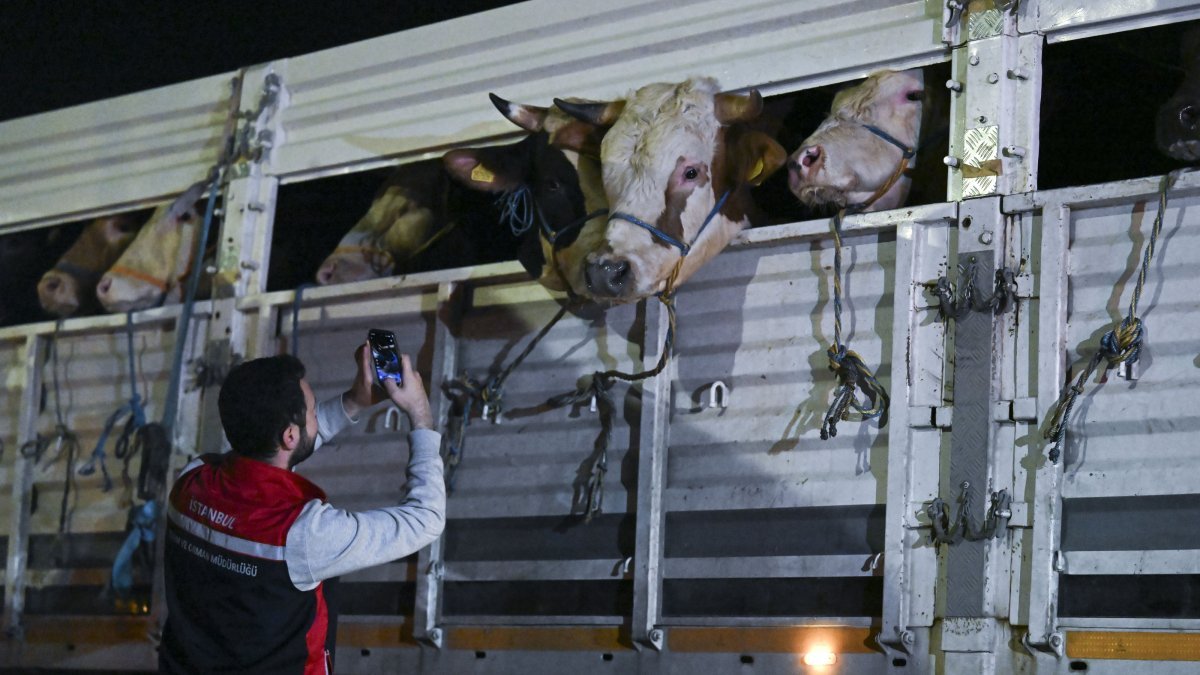
Livestock shipments to Istanbul have begun ahead of the upcoming Eid al-Adha holiday, as Turkish authorities stepped up inspections to ensure animal health, safety and compliance with transport regulations.
Teams from the Istanbul Provincial Directorate of Agriculture and Forestry launched inspections at the Riva Live Animal Transport Control Point on the Northern Marmara Highway, where trucks carrying sacrificial animals from Anatolia to Istanbul and the Thrace region undergo mandatory checks.
Suat Parıldar, director of the directorate, said all trucks transporting sacrificial animals to the European side of Istanbul and Thrace are required to complete clearance procedures at the checkpoint.
“We are conducting road inspections together with our provincial directorate and the General Directorate of Livestock,” Parıldar said. “We check veterinary health reports, transport documents and destination data for the animals. Controls are carried out both digitally and through physical documentation.”
Veterinarians also inspect the animals on-site for health screenings, he added.
Parıldar noted that the European side of Istanbul and the Thrace region have maintained a vaccinated disease-free status against foot-and-mouth disease since 2010, while also preserving protected status against peste des petits ruminants, commonly known as sheep and goat plague.
He said the Agriculture and Forestry Ministry introduced a “revolutionary” regulatory change beginning Jan. 1, 2026, allowing year-round passage of cattle into Thrace and Istanbul’s European side for breeding and fattening purposes under certain conditions.
According to Parıldar, the move aims to improve the sacrificial animal supply system in Thrace and Istanbul while making access to healthier and more affordable animals easier for consumers and ensuring sustainability for livestock breeders in Anatolia.
Authorities inspected around 750 livestock trucks at the same control point last year, taking legal action against 38 vehicles deemed unsuitable for animal transportation or operating without authorization, he said.
Officials also inspected more than 20,000 cattle and over 26,000 small livestock animals, with legal measures imposed on 373 cattle and 1,151 sheep and goats found ineligible for entry into Thrace and Istanbul’s European side.
Parıldar said approximately 60,000 cattle and more than 81,000 small livestock animals were transported to Istanbul last year for Eid al-Adha. Around 80,000 cattle and 94,000 sheep and goats were slaughtered in the city during the 2025 holiday season, with similar figures expected this year.
He added that 12 municipal animal markets in Istanbul have already begun operating for the holiday period.
The official also urged citizens to verify ear tags, vaccination records, veterinary health reports and animal passports before purchasing sacrificial animals.
Pregnant animals, breeding females that have not lost reproductive value and animals suspected of carrying health risks are prohibited from slaughter during the holiday, he said.
Parıldar also reminded buyers that cattle must be at least 2 years old and sheep or goats at least 1 year old to qualify for sacrifice under regulations.
Using the ministry’s “Tarım Cebimde” mobile application, consumers can access details including an animal’s breed, birth date and vaccination history by entering the ear tag number, he added.
“We will continue working meticulously 24/7 throughout and after the holiday to ensure citizens have a safe and reliable Eid al-Adha period with healthy animals,” Parıldar said.

