

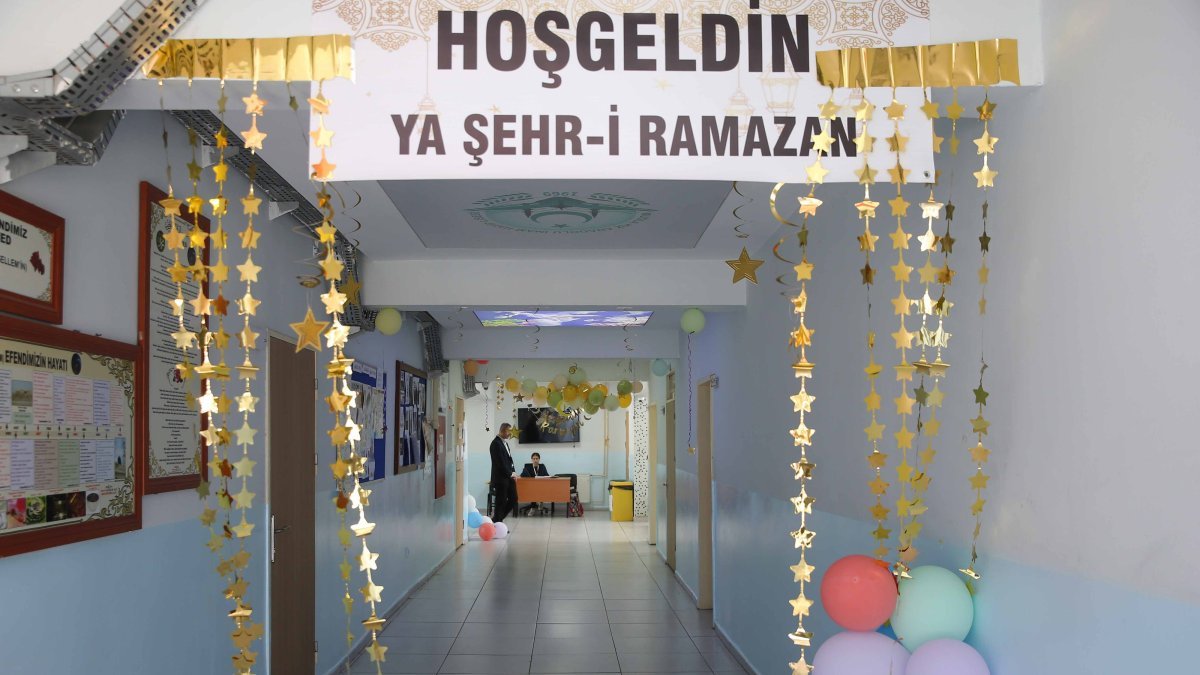
A new debate has emerged in recent days over school activities related to Islam’s holy month of Ramadan, after a group of 168 signatories, including journalists, artists and academics, issued a statement titled the “Secularism Declaration.” The statement, which critics said echoed the rhetoric of the Feb. 28 postmodern coup era, sparked widespread public reaction. Experts, however, argue that such informational and cultural activities are not in violation of secularism.
“If a declaration interprets secularism in a way that categorically excludes the public visibility of religion, or disregards the constitutional framework concerning religious education and religious practices, such an approach contradicts the freedom of religion guaranteed under Article 24. It even amounts to an assault on fundamental freedoms,” Zakir Avşar, a professor from Ankara Hacı Bayram Veli University, told Daily Sabah.
In the statement titled “We Defend Secularism Together,” 168 writers, artists, academics, journalists and representatives of professional organizations claimed that Ramadan activities were a violation of a secular state, saying, “We will not surrender to darkness.”
Reminding that Article 24 of the Constitution of the Republic of Türkiye stipulates that everyone has the right to declare, practice and worship in accordance with their religious beliefs and religious and moral education shall be conducted under the supervision and control of the state, and that compulsory courses on religious culture and ethics shall be included in the curriculum, Avşar stressed that, “Secularism does not mean hostility toward religion; rather, it signifies that the state maintains equal distance from all beliefs and ensures freedom of religion.”
National Education (MEB) Minister Yusuf Tekin also said the declaration reminded him of the Feb. 28 process, describing it as a malicious statement based on mind-reading.
“In their view, celebrating Christmas or Halloween is not contrary to secularism, but when it comes to Ramadan activities that reflect the continuation of our cultural heritage, secularism somehow comes to mind.”
Tekin also announced that he would initiate legal proceedings against the signatories, arguing that the text was ill-intentioned and ideological.
“Just as they exercise their democratic rights, I will exercise mine,” Tekin said.
Avşar noted that the Feb. 28 process marked a period in Türkiye when secularism was applied within a rigid, exclusionary and prohibitive framework. In the field of education in particular, practices such as persuasion rooms, headscarf bans and the coefficient system, along with restrictive measures targeting religious practices, resulted in violations of fundamental rights and freedoms.
Given this historical background, he said, “any tendency to reinterpret secularism through a prohibitive and uniform approach inevitably evokes memories of that era.”
On Feb. 28, 1997 military memorandum was issued by Türkiye’s National Security Council (MGK), which has since been dubbed the “postmodern coup.” The coup was no different than others otherwise. It targeted certain members of the public and kept fear of military intervention alive whenever powerful generals disliked the government.
During the period, the lives of millions took a sharp turn after the Turkish army, then still adhering to a tradition of self-claimed “tutelage” of Türkiye’s secular elite, joined forces with the judiciary organs in vehement opposition to what they called “reactionary forces” in power. This especially affected women expelled from schools for wearing headscarves and men deemed “too conservative” to hold public sector jobs and were fired, as well as others who suffered threats and lengthy legal processes.
Moreover, Tacettin Kutay, an academic at Turkish-German University and a columnist expert argued that the core characteristic of French Enlightenment thought and its model of secularism is built on disregarding the “other” and, if possible, eliminating elements associated with it.
“Unfortunately, in Türkiye, those who describe themselves as secular have largely shaped their intellectual framework based on French Enlightenment traditions and therefore do not operate outside that practice. For this reason, we consistently witness that those involved in these debates express discomfort with the very existence of the other side,” he said.
Previously, Suat Özçağdaş, head of the Education Policy Board of the main opposition Republican People’s Party (CHP), told reporters at Parliament that the government prefers opening Quran courses and described those as structures of “unclear nature.” Accusing the Education Ministry of paving the way for religious orders and communities, Özçağdaş said, “You are hostile to secular education; you are hostile to Türkiye’s secularism.”
Kutay further remarked that it remains unclear what, specifically, has caused discomfort over Ramadan-related activities in schools. “Was any child forced to fast? Was there an imposition outside the curriculum? No,” he said, adding that the reaction appears to stem from unease among those who do not accept that religious elements are also part of cultural heritage.
He concluded that Islam, which constitutes a part of Türkiye’s cultural heritage, is consistently rejected by what he described as an aggressive minority, whose demands are being imposed despite representing a minority view.
“As in nearly every year, the approach of Ramadan in 2026 has prompted statements from circles that describe themselves as secular,” he said, characterizing the circles as hostile toward the nation’s religious beliefs and values.
“It is not surprising,” Ekrem Kızıltaş, a columnist and author, said, commenting on the declaration.
According to Kızıltaş, this year’s debate appears to have been fueled by the fact that Ramadan began close to the anniversary of the Feb. 28 process and by the Education Ministry’s circular encouraging broader coverage of Ramadan-related themes in schools.
Last week, speaking at the Governors’ Meeting Program, President Recep Tayyip Erdoğan said they would organize various school activities to ensure that children, the guarantee of our future, are aware of the significance of the holy days of Ramadan and benefit from what he described as their atmosphere of spiritual abundance.
“There is no debate on secularism in Türkiye, and freedoms are in no way restricted,” Erdoğan said. “We will never deviate from what we believe is right, without paying heed to the ravings of an aggressive group that cannot tolerate our nation living its faith freely.”
On the other hand, Kızıltaş also pointed out that the anger stemming from the detention of several mayors from the CHP on charges such as bribery and corruption may also have played a role in prompting such statements. The group in question, he added, lacks any connection to objectivity, noting that both the president and the education minister have already delivered the necessary responses.
Regarding the critics of the Ramadan activities at schools, he concluded: “It can also be said that, beyond being alienated from the beliefs and values of a nation that is 99% Muslim, their aggressive tone causes them to undermine their own position the more they speak.”
