

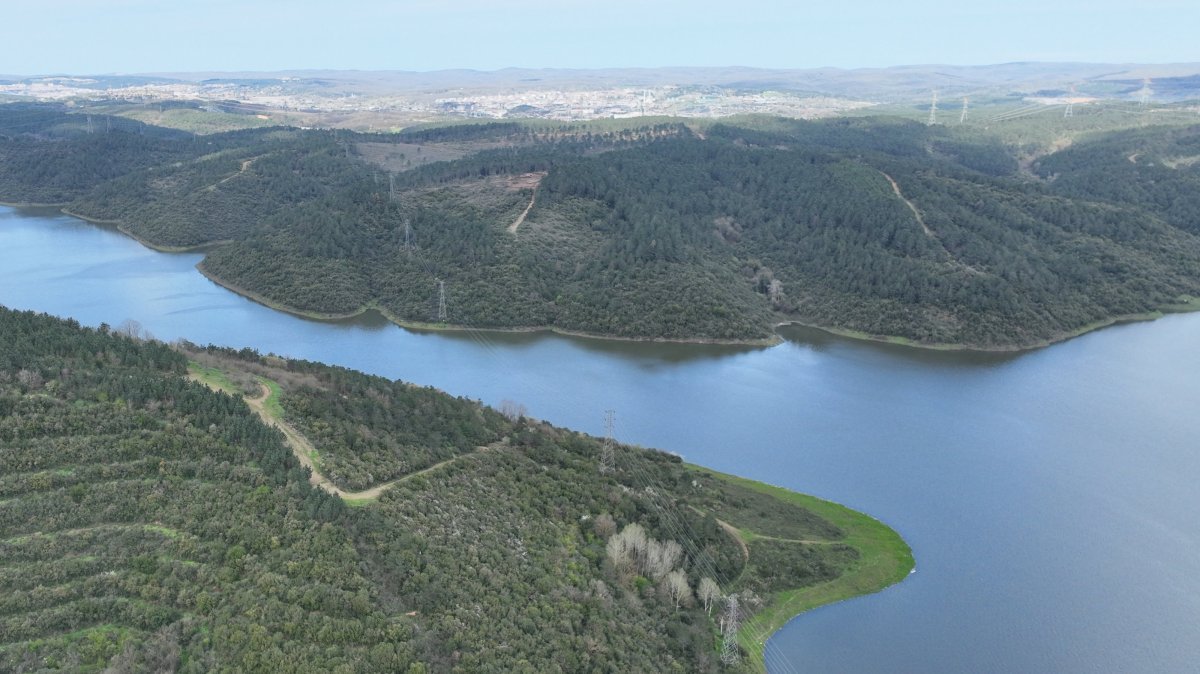
The average occupancy rate of dams supplying drinking water to Istanbul has increased to 70.05% following recent rainfall, according to data released by the Istanbul Water and Sewerage Administration (ISKI).
While the rise signals short-term relief for Türkiye’s largest metropolis, experts caution that long-term structural water security challenges persist due to rising demand, limited storage capacity, and climate-related pressures.
ISKI data shows that rainfall has contributed to a gradual recovery in reservoir levels across the city’s water system. However, distribution remains uneven among the ten main reservoirs supplying the megacity.
The highest levels were recorded at Elmalı Dam with 92.54%, Ömerli Dam at 92.37% and Darlık Dam at 86.11%, indicating near-saturation in some critical storage points.
On the lower end, Sazlıdere Dam stood at 45.36%, while Terkos Dam registered 56.12% and Büyükçekmece Dam 56.47%, reflecting continued vulnerability in several key supply sources.
Other reservoirs also showed moderate-to-strong levels, including Istrancalar at 76.36%, Alibey at 67.56%, Kazandere at 62.10%, and Pabuçdere at 57.99%. Authorities noted that these fluctuations are typical in a multi-reservoir system heavily dependent on seasonal rainfall patterns and external water transfers.
According to official figures, Istanbul received 389.88 kilograms of rainfall per square meter across the dam catchment areas this year. The city’s total reservoir storage capacity stands at 868.683 million cubic meters, while the current stored water is measured at 606.19 million cubic meters.
Despite the recent improvement, the system remains under continuous pressure due to high consumption levels and structural limitations in natural replenishment.
Water inflow support from external systems also continues to play a critical role in maintaining supply stability. This year alone, 267.28 million cubic meters of water have been supplied through the Melen and Yeşilçay systems, which function as key regulatory sources feeding into Istanbul’s broader water network.
In parallel, treatment plants have delivered approximately 300.047 million cubic meters of potable water to meet the city’s daily demand.
Daily consumption in Istanbul remains exceptionally high. ISKI data indicates that the city used 2.925 million cubic meters of water in a single day, with 595,000 cubic meters drawn directly from reservoirs and the remaining 2.33 million cubic meters supplied via external water systems.
Given the scale of demand, experts underline that reservoir recovery alone is insufficient to ensure long-term water security.
Historical data shows that Istanbul’s dam levels have varied significantly in recent years, ranging from periods above 80%-90% to sharp drops in drier seasons.
Compared to this pattern, the current level of 70.05% remains below stronger years and reflects only a partial recovery, highlighting ongoing volatility in the city’s water availability.
Despite the recent gains driven by rainfall, experts stress that Istanbul continues to operate under structurally constrained water conditions. Istanbul University Faculty of Aquatic Sciences professor Meriç Albay noted that reservoir levels remain around 11% points lower than last year, warning that the apparent improvement may conceal deeper, ongoing system vulnerabilities.
Albay stated that while recent precipitation has provided meaningful short-term gains, Istanbul’s long-term water balance remains fragile. He noted that the city’s total storage capacity, even at full utilization, falls significantly short of annual demand, which is estimated at approximately 1.5 billion cubic meters.
In contrast, maximum reservoir capacity remains below 900 million cubic meters, creating a structural supply gap that is bridged through external transfers.
He emphasized that Istanbul’s dependence on external transfer systems such as Melen and Trakya exposes the city to significant environmental vulnerabilities, including regional droughts and climate variability.
Even when reservoirs are fully stocked, the overall system still falls short of meeting demand, underscoring the need for sustained inflows and stable rainfall patterns.
He also highlighted critical infrastructure inefficiencies, particularly water losses and leakage within distribution networks, arguing that these significantly reduce usable supply. Under current high-demand conditions, he stressed that there is effectively “no margin for loss,” calling for urgent modernization and stronger management frameworks.
Rapid urbanization and population growth were identified as additional structural pressures. With Istanbul exceeding 16 million residents, expanding urban density continues to drive higher consumption while reducing natural water absorption through land sealing and construction activity.
Climate-related risks further compound the challenge, with declining snow accumulation weakening river flows that feed key reservoirs. This trend increases the likelihood of consecutive dry years, potentially impacting both local basins and external supply systems such as Melen.
Behavioral change was also identified as essential, with consumption patterns across domestic, industrial, and agricultural sectors contributing significantly to systemic stress. Educational initiatives were recommended to embed water conservation awareness from early schooling onward.

