


Iran and Iranian-backed militias fired missiles at Israel and Arab states, apparently hitting the U.S. Embassy compound in Kuwait, while Israel and the United States pounded targets in Iran as the war expanded on Monday with statements of defiance and increasing casualties.
The U.S. military claimed Kuwait had “mistakenly shot down” three American F-15E Strike Eagles during a combat mission while attacks from Iranian aircraft, ballistic missiles and drones were underway.
At least 555 people have been killed in Iran so far by the U.S.-Israeli campaign, the Iranian Red Crescent Society said and more than 130 cities across the country, having come under attack. Eleven people have been killed in Israel and 31 in Lebanon, according to authorities there.
Lebanon’s government said Hezbollah’s overnight attack against Israel was “illegal” and demanded the group hand over its weapons. Lebanese Prime Minister Nawaf Salam said only the state can decide whether to go to war or peace and called on the Lebanese military to prevent the firing of projectiles and detain anyone involved.
In Kuwait, fire and smoke rose from inside the U.S. Embassy compound. It wasn’t exactly clear where in Kuwait the U.S. aircraft were shot down, but the U.S. Central Command said all six pilots ejected safely and are in stable condition.
“Kuwait has acknowledged this incident and we are grateful for the efforts of the Kuwaiti defense forces and their support in this ongoing operation,” it said.
Iranian state television claimed Iran had targeted U.S. aircraft, without elaborating. Before the embassy compound was hit, the U.S. issued a warning to Americans in Kuwait to take cover and for others to stay away.
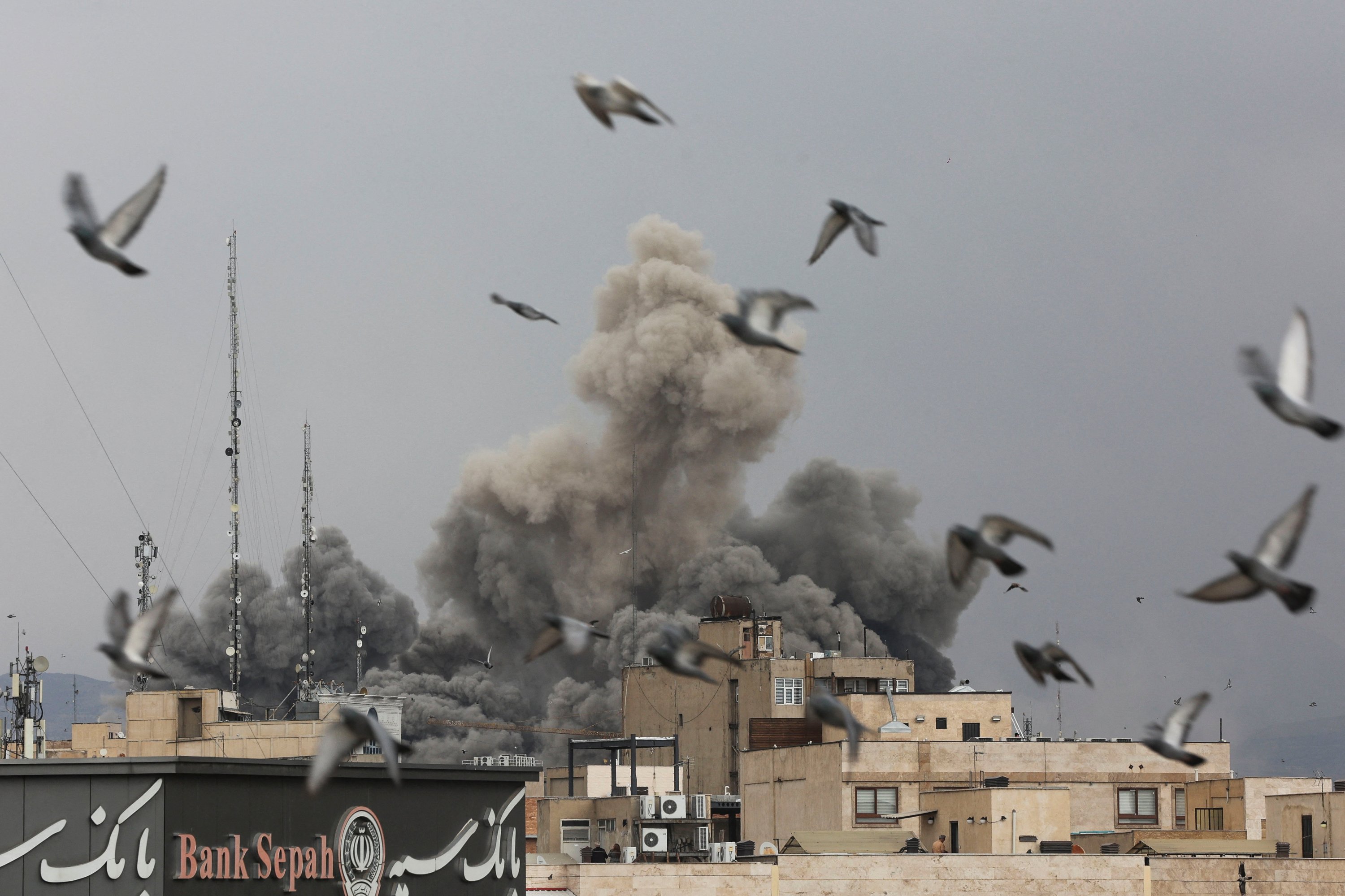
On Monday afternoon, multiple airstrikes hit Tehran, Iran’s capital, while top Iranian security official Ali Larijani vowed on X that “we will not negotiate with the United States.”
In Iraq, a pro-Iranian militia claimed responsibility for a drone attack targeting U.S. troops at the Baghdad airport, the day after it said it fired at a U.S. base in the city of Irbil in the north, and the Greek Cypriot administration said a drone attack targeted a British base on the Mediterranean island.
Israel and the U.S. bombed Iranian missile sites and targeted its navy, claiming to have destroyed its headquarters and multiple warships.
World markets were rattled by the fighting and oil prices soared.
Saudi Arabia’s Ras Tanura oil refinery came under a drone attack on Monday, with defenses downing the incoming aircraft, a military spokesman told the state-run Saudi Press Agency.
Online videos from the site appeared to show thick black smoke rising after the attack. Even successfully intercepted drones cause debris that can spark fires and injure those on the ground.
Ras Tanura, near the city of Dammam in eastern Saudi Arabia, is one of the world’s largest oil refineries with a capacity of over half a million barrels of crude oil a day. It was temporarily shut down as a precaution after the attack, Saudi state television reported.
Oman said a bomb-carrying drone boat exploded against the Marshall Islands-flagged oil tanker in the Gulf of Oman on Monday, off the coast of the sultanate’s capital of Muskat, killing one mariner. The state-run Oman News Agency said the dead crew member was from India.
Earlier in the day, debris fell on Kuwait’s Ahmadi oil refinery, injuring two workers, after drones were shot down, the state-run KUNA news agency reported.
Iran’s decision to expand its attacks to major regional oil infrastructure adds a new element to the war gripping the Middle East, directly targeting the lifeblood of the area’s economy.
Iran has also threatened ships in the Strait of Hormuz, the narrow mouth of the Persian Gulf through which a fifth of all oil traded passes. Several ships have been attacked as well.
Sascha Bruchmann, a defense analyst with the International Institute for Strategic Studies in Bahrain, told The Associated Press that Iran’s goal in hitting energy infrastructure is to “cause global backlash.”
So far, however, “this is not the wholesome destruction of critical infrastructure the Iranian regime seeks,” Bruchmann said.
Iran’s ambassador to the U.N. nuclear watchdog, the International Atomic Energy Agency, Reza Najafi, told reporters that the U.S.-Israeli airstrikes had targeted Iran’s Natanz nuclear enrichment site Sunday.
“Again, they attacked Iran’s peaceful safeguarded nuclear facilities yesterday,” he said. “Their justification that Iran wants to develop nuclear weapons is simply a big lie.”
Israel and the U.S. have not acknowledged strikes at the site, which the U.S. bombed back in the 12-day war between Iran and Israel in June. The Israeli military also did not immediately comment on Najafi’s allegation.
Israel has not publicized specific targets in Iran but has said that it is targeting “leadership and nuclear infrastructure.”
As the attacks on Iran continued, Hezbollah said it fired missiles from Lebanon into Israel early Monday in response to the killing of Iranian Supreme Leader Ali Khamenei and “repeated Israeli aggressions.”
There were no reports of injuries or damage and Israel said that it had intercepted one projectile while several fell in open areas.
Israel retaliated with strikes on Lebanon, killing at least 31 people and wounding 149 others, according to Lebanon’s Health Ministry. About two thirds of the dead were in the country’s south.
Lebanon’s government said it was holding an emergency meeting after Hezbollah’s attack on Israel triggered the Israeli airstrikes.
Iran has been firing missiles at Israel and Arab states in a counteroffensive since the joint America-Israeli attack Saturday that killed Khamenei and many top Iranian officials.
Gulf Arab states have warned that they could retaliate against Iran after strikes that hit key sites and killed at least five civilians and U.S. President Donald Trump promised Washington would “avenge” the deaths of three American troops who were killed in Kuwait, while predicting more casualties.
“Sadly, there will likely be more before it ends,” Trump said. “That’s the way it is.”
Trump has urged Iranians to “take over” their government and, while he has also signaled he would be open to dialogue with new leadership there following the death of Khamenei, suggested Sunday there was no end in sight to the military operations.
“Combat operations continue at this time in full-force, and they will continue until all of our objectives are achieved,” he said in a video message. “We have very strong objectives,” he added, without elaborating.
The U.S. military said B-2 stealth bombers struck Iran’s ballistic missile facilities with 2,000-pound bombs. Trump said on social media that nine Iranian warships had been sunk and that the Iranian navy’s headquarters had been “largely destroyed.”
Others have mostly stayed out of the war and pressed for diplomacy. But in an indication that the conflict could draw in other nations, Britain, France and Germany said Sunday they were ready to work with the U.S. to help stop Iran’s attacks.
The weekend attacks were the second time in eight months that the U.S. and Israel had combined against Iran, in a startling show of military might for an American president elected on an “America First” platform and pledged to keep out of “forever wars.”
In the 12-day war last June, Israeli and American strikes greatly weakened Iran’s air defenses, military leadership and nuclear program. But the killing of Khamenei, who ruled Iran for more than three decades, creates a leadership vacuum, increasing the risk of regional instability.
Tehran’s streets have been largely deserted with people sheltering during airstrikes. The paramilitary Basij force, which has played a central role in crushing recent protests, set up checkpoints across the city, according to witnesses.
In the northern Iranian city of Babol, a student, speaking anonymously over concerns of retribution, told the AP that armed riot police were on the streets Saturday night and into the early hours of Sunday after the death of Khamenei.
“We don’t know whether to be happy about the elimination of the criminals who oppress us or to remain silent in the face of the U.S. and Israel’s war against the country and its interests and the terror that is taking place,” he said.
In Israel, rescue services have confirmed several locations have been hit by Iranian missiles, including Jerusalem and a synagogue in Beit Shemesh, where nine people were killed and 28 wounded, bringing the overall death toll in the country to 11.
The World Health Organization called Monday for sparing civilians and healthcare facilities in the Middle East amid the escalating conflict.
“The protection of civilians and health care must be absolute,” Hanan Balkhy, regional dietitian at WHO wrote on social media. “All parties must … ensure medical facilities remain protected.”
