

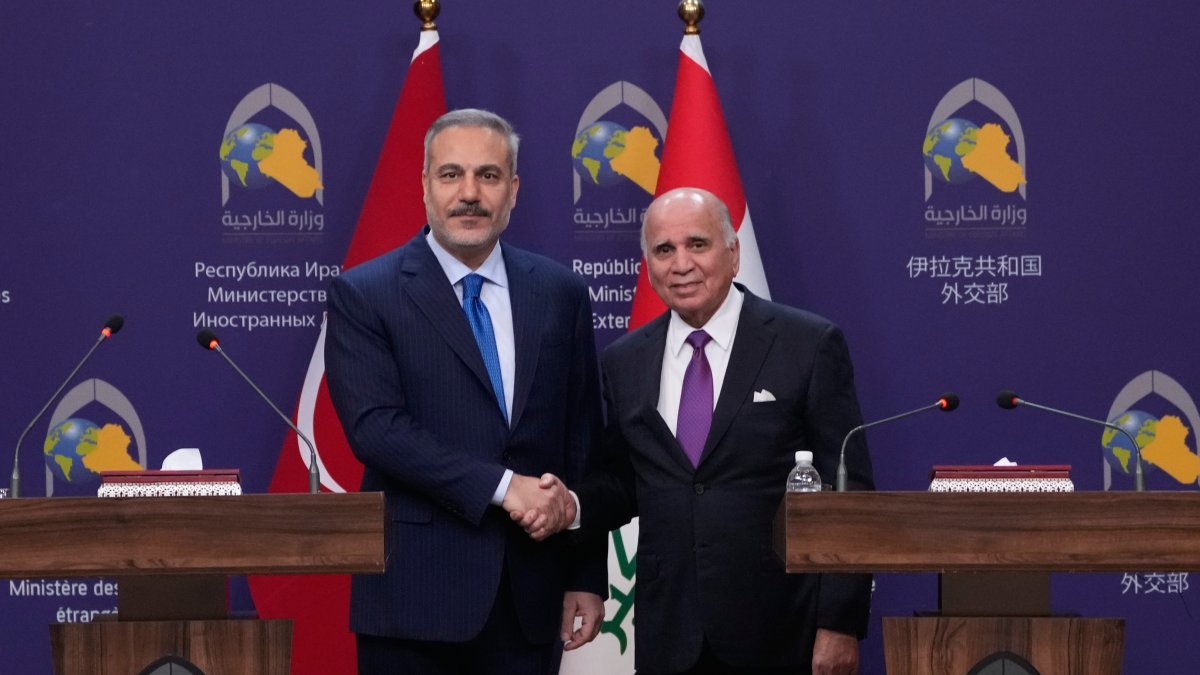
Türkiye’s Foreign Minister Hakan Fidan met Iraqi Defense Minister Thabit Abbasi in Ankara on Sunday and separately held a phone call Monday with Nechirvan Barzani, the president of Iraq’s Kurdistan Regional Government (KRG), discussing recent developments, Turkish diplomatic sources said.
Fidan’s talks came days after President Recep Tayyip Erdoğan held a phone call with Iraqi Prime Minister Mohammed S. Al Sudani, where they discussed bilateral relations as well as regional and global developments. The two leaders reviewed steps to further enhance cooperation between Türkiye and Iraq, with a particular focus on trade and broader economic engagement. Erdoğan underscored that Ankara would continue taking concrete steps to deepen ties across multiple sectors, stressing that stronger cooperation serves the mutual interests of both neighboring countries. The president also emphasized the importance of intensifying collaboration in the fight against terrorism, noting that closer coordination would benefit both Türkiye and Iraq and contribute to regional stability. The leaders reaffirmed their commitment to maintaining dialogue and strengthening the longstanding partnership between the two countries.
In another phone call on Monday, Hakan Fidan and Faisal bin Farhan also exchanged views about bilateral matters, according to the sources. Erdoğan visited Saudi Arabia on Feb. 3 and later traveled to Egypt, during which agreements were signed with the two countries in various fields, particularly energy. Ankara and Riyadh have announced a broad expansion of cooperation across economic, energy, defense and regional security fields following Erdoğan’s official visit to the kingdom, with both governments emphasizing shared interests, historic ties and a joint commitment to stability across the region. The two governments said they would continue strengthening coordination under the Turkish-Saudi Coordination Council, covering fields such as digital economy, artificial intelligence, space technologies, civil aviation, logistics, culture, youth, education, media, environment, food security and customs. They affirmed readiness to enhance defense ties and expand collaboration against terrorism, extremism, cyberthreats and transnational crime.

