

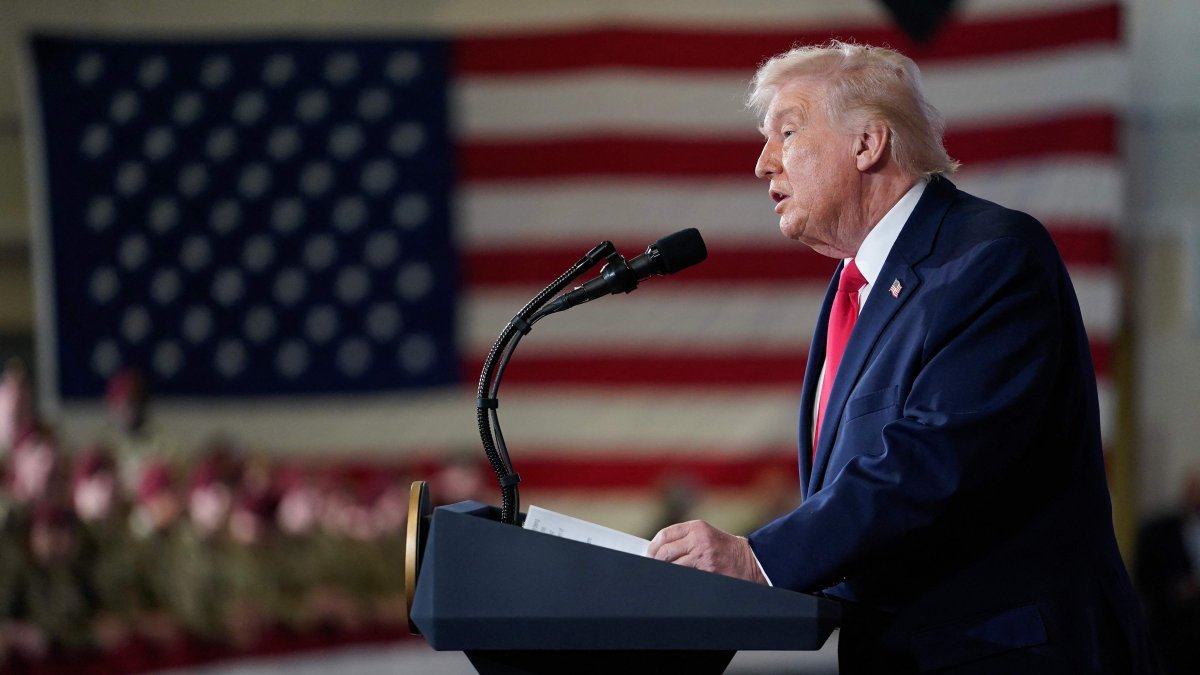
President Donald Trump said Friday he is deploying a second U.S. aircraft carrier to the Middle East as he intensifies pressure on Iran to reach a new agreement over its nuclear program.
The USS Gerald R. Ford, the world’s largest aircraft carrier, is being sent from the Caribbean Sea to the Mideast to join other warships and military assets the U.S. has built up in the region. The planned deployment comes just days after Trump suggested another round of talks with the Iranians was at hand. Those negotiations didn’t materialize as one of Tehran’s top security officials visited Oman and Qatar this week and exchanged messages with U.S. intermediaries.
“In case we don’t make a deal, we’ll need it,” Trump told reporters about the second carrier as he left the White House for a military base in North Carolina. He added, “It’ll be leaving very soon.”
Already, Gulf Arab nations have warned that any attack could spiral into another regional conflict in a Mideast still reeling from the Israel-Hamas war in the Gaza Strip. Meanwhile, Iranians are beginning to hold 40-day mourning ceremonies for the thousands killed in Tehran’s bloody crackdown on nationwide protests last month, adding to the internal pressure faced by the sanctions-battered Islamic Republic.
The Ford, whose new deployment was first reported by The New York Times, will join the USS Abraham Lincoln and its accompanying guided-missile destroyers, which have been in the region for over two weeks. U.S. forces already have shot down an Iranian drone that approached the Lincoln on the same day last week that Iran tried to stop a U.S.-flagged ship in the Strait of Hormuz.
It is a quick turnaround for the Ford, which Trump sent from the Mediterranean Sea to the Caribbean last October as the administration built up a huge military presence in the lead-up to the surprise raid last month that captured then-Venezuelan President Nicolás Maduro.
It also appears to be at odds with the Trump administration’s national security and defense strategies, which put an emphasis on the Western Hemisphere over other parts of the world.
In response to questions about the movement of the Ford, U.S. Southern Command said American forces in Latin America will continue to “counter illicit activities and malign actors in the Western Hemisphere.”
“While force posture evolves, our operational capability does not,” Col. Emanuel Ortiz, spokesperson for Southern Command, said in a statement. U.S. “forces remain fully ready to project power, defend themselves, and protect U.S. interests in the region.”
Trump, who is in Fort Bragg to celebrate members of the special forces who captured Maduro, warned Iran this week that failure to reach a deal with his administration would be “very traumatic.” Iran and the United States held indirect talks in Oman last week.
“I guess over the next month, something like that,” Trump said Thursday when asked about his timeline for striking a deal with Iran on its nuclear program. “It should happen quickly. They should agree very quickly.”
Trump held lengthy talks with Israeli Prime Minister Benjamin Netanyahu on Wednesday and said he insisted to Israel’s leader that negotiations with Iran needed to continue. Netanyahu is urging the administration to press Tehran to scale back its ballistic missile program and end its support for militant groups such as Hamas and Hezbollah as part of any deal.
The USS Ford deployed in late June 2025, which means the crew will have been deployed for eight months in two weeks time. While it is unclear how long the ship will remain in the Middle East, the move sets the crew up for an unusually long deployment.

